A practical guide for South Australian night sky photographers
1. Introduction — Aurora in Australia Is More Common Than You Think
While the Northern Lights often dominate global attention, the Aurora Australis can be just as spectacular—especially during periods of high solar activity. In South Australia, strong auroral displays occasionally reach the southern horizon and even produce visible pillars and vivid colour layers.
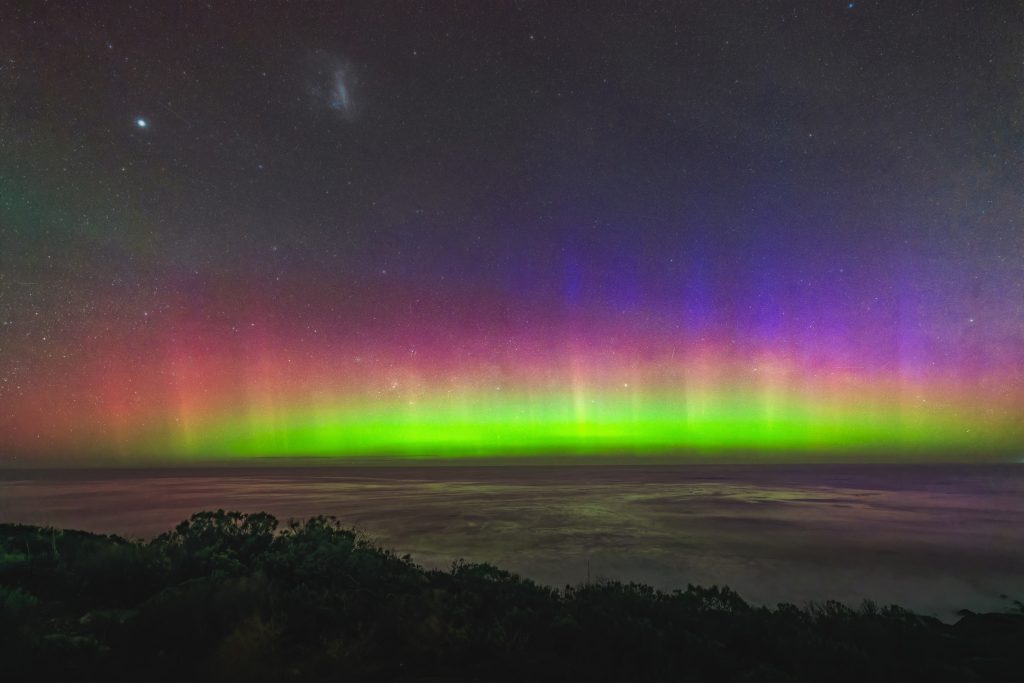
This guide walks you through how to predict aurora, how to prepare, where to go, recommended camera settings, and a simple post-processing workflow, based on my own experience photographing the November 12 aurora from Muhan Viewpoint with a Sony A7R5 and 16–35mm GM II.
2. How to Predict the Aurora — The Tools That Actually Matter
Aurora prediction can seem confusing at first, but once you understand a few key parameters, it becomes surprisingly straightforward.
In Australia, the most reliable forecasting source is the official Australian Space Weather Services (SWS) website operated by the Bureau of Meteorology.
2.1 Key Indicators on the SWS Aurora Forecast Page
1) Kp Index (0–9 scale)
The Kp index represents global geomagnetic activity.
- Kp 4–5 — Aurora usually only visible in Tasmania
- Kp 6–7 — Good chance for South Australia (southern horizon glow)
- Kp 7+ — Strong, vivid pillars; excellent for photography
On November 12, the Kp index peaked high enough to create bright green, red, and purple structures visible across SA’s southern coast.
2) Bz (North–South Magnetic Field Component)
This is one of the most important parameters.
To put it simply:
- Bz negative (southward) → good
- Bz positive (northward) → bad
When Bz is below –10 nT for an extended period, the odds of a visible aurora increase dramatically.
3) Solar Wind Speed (V)
Higher wind speeds carry more charged particles.
- Ideal: above 500–600 km/s
- More speed = brighter aurora
4) Solar Wind Density (p/cm³)
Density amplifies auroral brightness.
- Density > 10 p/cm³ usually signifies strong displays
- Sudden density spikes often correlate with rapid brightening
5) SWS Aurora Forecast Oval
The forecast map on SWS shows the extent of the auroral oval centered around Antarctica.
- If the oval expands northward toward Tasmania and the Great Australian Bight, South Australia has a good chance of seeing activity.
You can access SWS here:
https://www.sws.bom.gov.au/Aurora
2.2 Useful Aurora Apps (Confirmed to Exist in AU App Store)
Below are only verified apps available in the Australian iOS App Store:
- My Aurora Forecast & Alerts
Simple interface, real-time KP, cloud maps, and alerts. - SpaceWeatherLive
Very accurate data, including Bz, solar wind speed, density, and geomagnetic charts.
These apps are great for quick checks and alerts, but the SWS website should always be your main forecasting reference.
3. Moon Phase and Weather — Two Critical Elements
3.1 Does Moonlight Affect the Aurora?
Yes, although it depends on how strong the aurora is.
- Full Moon — reduces contrast, washes out faint aurora
- Half Moon / Crescent — manageable
- New Moon — best visibility and colours
However, strong aurora (Kp 7+) can still look impressive even under moonlight.
For the clearest colours: aim for nights near the new moon.
3.2 Cloud Forecasting with Windy (ACCESS & ACCESS-C Models)
Clouds are the real enemy.
The Windy app is incredibly accurate for South Australia.
Recommended models:
- ACCESS
- ACCESS-C (higher resolution)
Check:
- High cloud → worst for aurora
- Mid cloud
- Low cloud (can block horizon glow)
For aurora photography:
Clear or mostly clear sky is ideal.
Windy: https://www.windy.com/
4. Best Aurora Viewing Locations Near Adelaide
South Australia has several excellent south-facing spots that consistently produce good results:
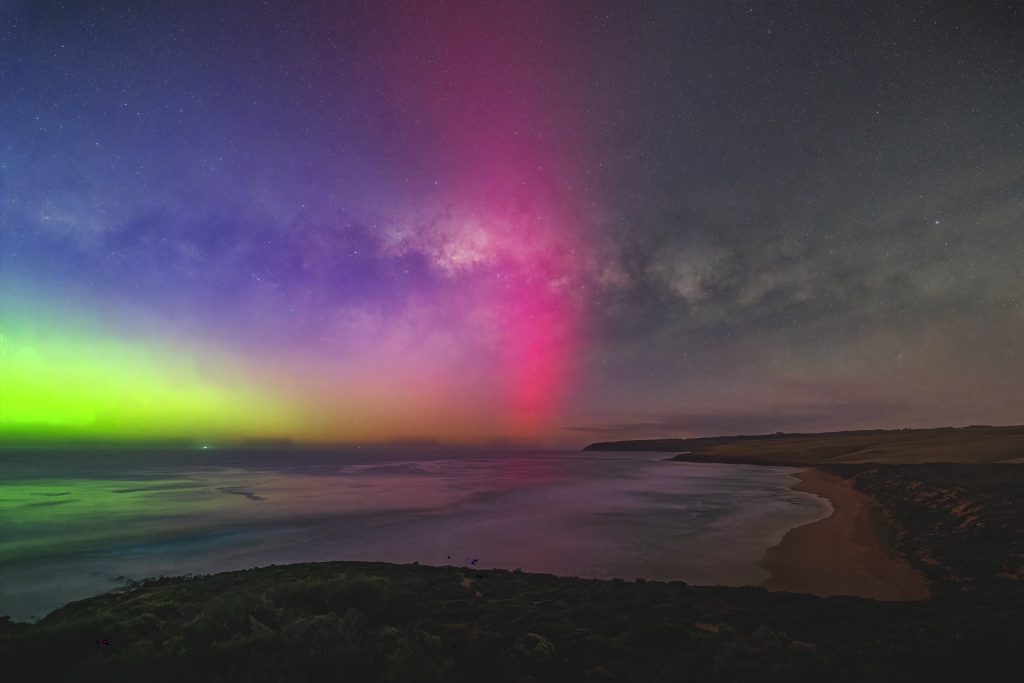
Muhan Viewpoint
- One of the best south-facing vantage points
- Dramatic coastline
- Very low light pollution
- My November 12 aurora images were taken here
Waitpinga Beach
- Wide unobstructed southern horizon
- Easy access and parking
- Popular for both aurora and astrophotography
Rosetta Head (The Bluff) — Victor Harbor
- High elevation with a clean ocean horizon
- Excellent for strong aurora pillars
Petrel Cove
- Great for foreground compositions
- Southern view suitable for aurora bands
Cape Jervis
- Very dark
- Extremely low southern horizon
- Excellent for wide-angle aurora bands
5. Recommended Camera Gear and Settings
5.1 Lens Recommendations
Aurora photography benefits from lenses that are:
- Wide
- Fast
- Sharp wide open
Excellent choices:
- 14–24mm f/2.8
- 16–35mm f/2.8 (my setup)
- 20mm f/1.8
- 24mm f/1.4
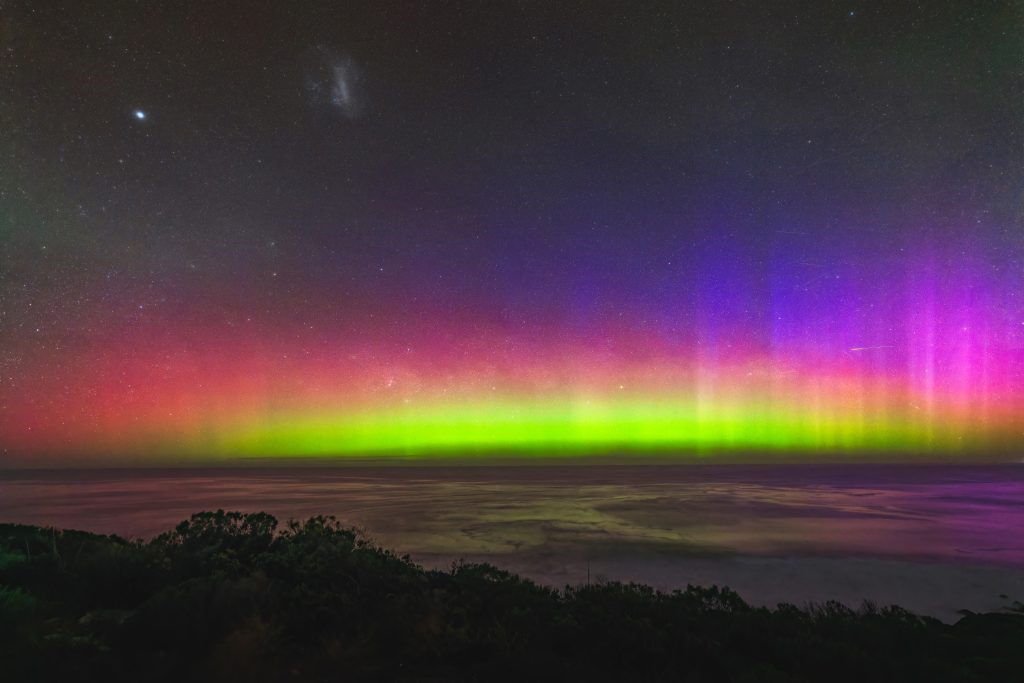
5.2 My Real Shooting Setup on November 12
- Sony A7R5
- Sony 16–35mm GM II
- Shot at 16mm
- f/2.8, 10s, ISO 1600
This combination delivered a wide field of view and excellent colour response.
5.3 General Recommended Aurora Settings
| Setting | Recommendation |
|---|---|
| Aperture | f/1.4–f/2.8 |
| Shutter | 3–10 seconds |
| ISO | 1600–6400 |
| Focus | Manual on a bright star |
| White Balance | 3500–4000K (cool tones look more natural) |
Why not use longer exposures?
Aurora moves quickly.
Long exposures smear aurora structure into a green fog.
3–10 seconds keeps colours and pillars crisp.
6. Simple Post-Processing Workflow
Aurora photos don’t need complicated editing.
A clean and natural look is often best.
Recommended adjustments:
- Denoise (DxO PureRAW or Lightroom AI Denoise)
- Lower colour temperature to maintain natural blue night sky
- Increase clarity for aurora structure
- Add a touch of Dehaze for sky contrast
Avoid heavy saturation—aurora colours can become unrealistic very quickly.
7. The Science Behind the Aurora Australis
Aurora Australis occurs when charged particles from the Sun collide with atoms in Earth’s atmosphere, producing glowing colours near the magnetic poles.
7.1 How Aurora Forms
- Solar wind from coronal holes or solar flares travels toward Earth
- Earth’s magnetic field guides particles toward the poles
- Particles collide with oxygen and nitrogen atoms
- Energy is released as light—aurora
During strong geomagnetic storms, the auroral oval expands northward, making the Southern Lights visible from South Australia.
7.2 Why Aurora Has Different Colours
Different gases glow at different wavelengths:
| Colour | Gas | Altitude | Notes |
|---|---|---|---|
| Green (557.7 nm) | Oxygen | ~100–150 km | Most common aurora colour |
| Red (630.0 nm) | Oxygen | >200 km | Appears during strong events |
| Purple / Blue | Nitrogen | <100 km | Found in pillars and lower edges |
| Pink | Oxygen + nitrogen mix | Various | Usually in dynamic beams |
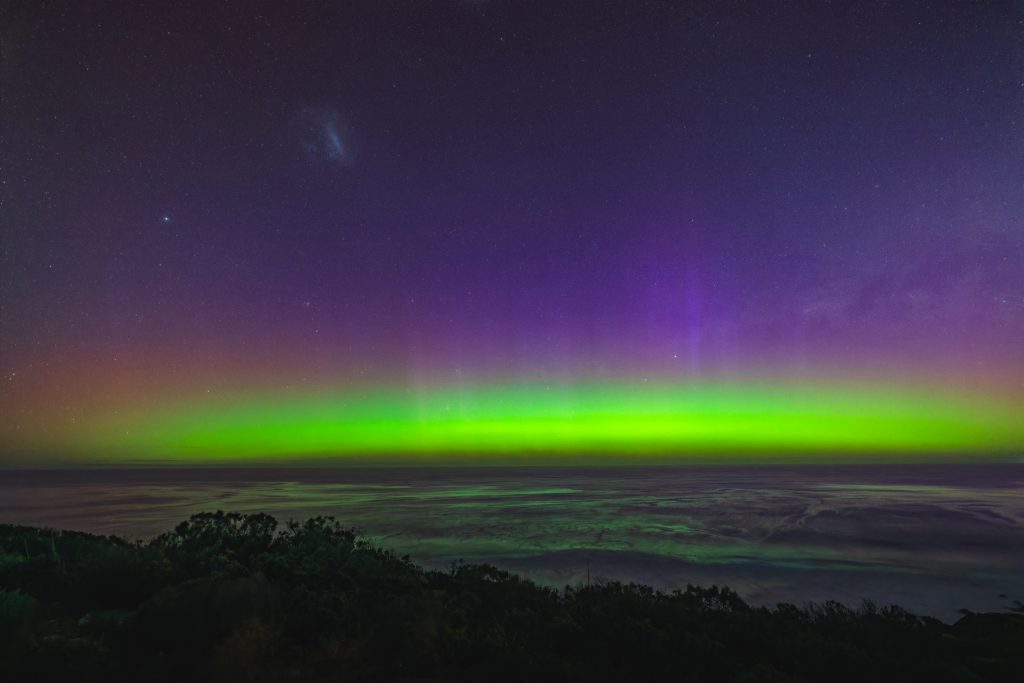
My November 12 images include:
- Bright green bands
- Strong red upper layers
- Purple and pink aurora pillars
A clear sign of a major geomagnetic disturbance.
1 Comment. Leave new
太专业了,把你的见解与实践让更多的人看到吧。