A galaxy cluster astrophotography journey across 500 million light-years
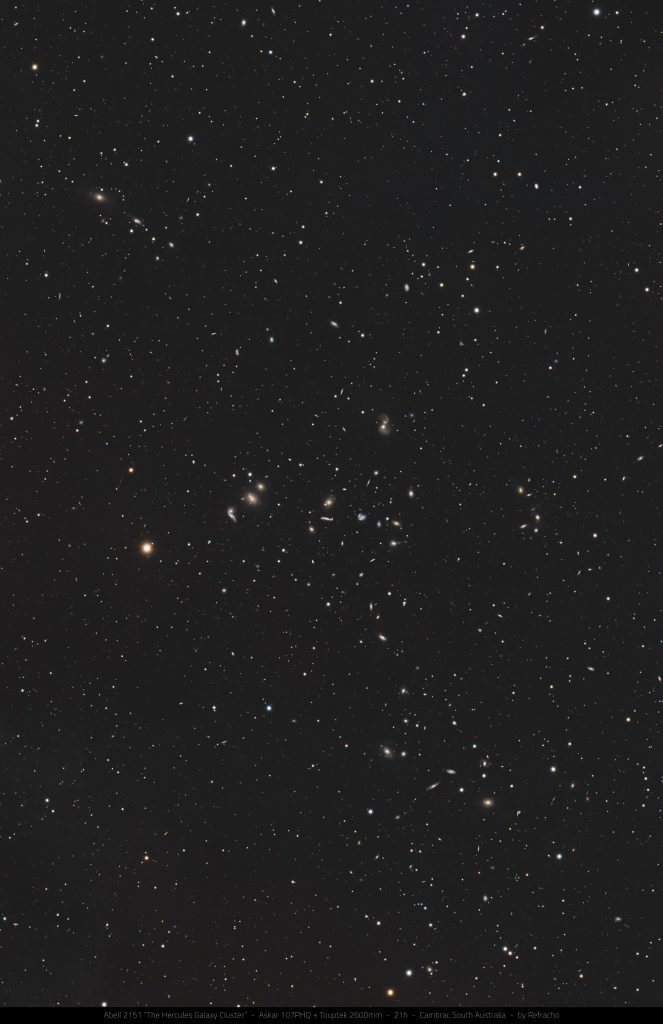
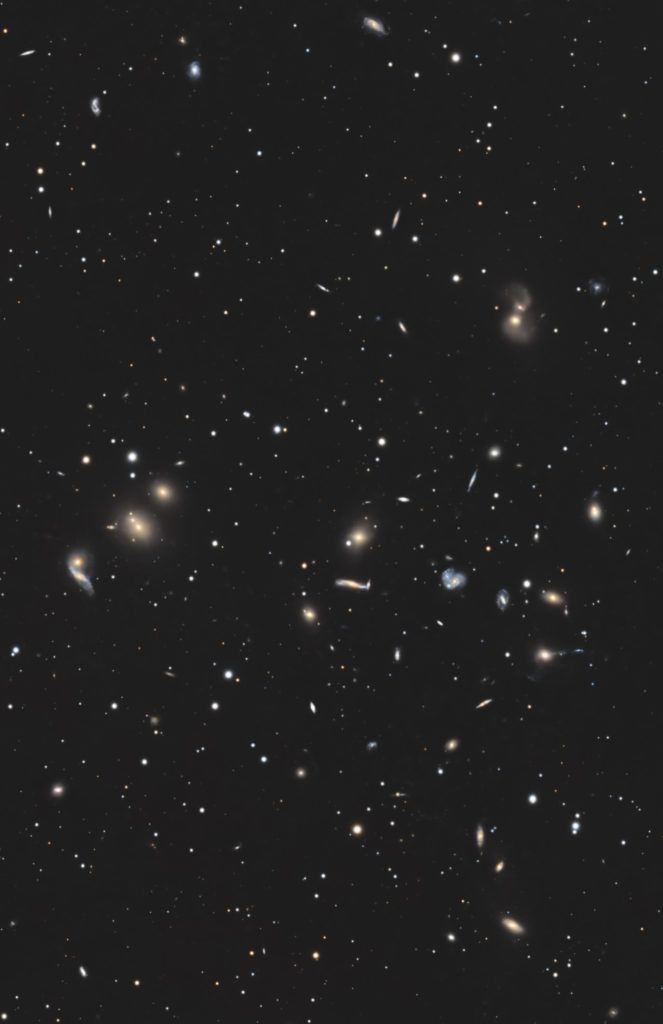
Abell 2151: A Young Galaxy Cluster Still Taking Shape
Abell 2151, better known as the Hercules Galaxy Cluster, is a large gravitational association of galaxies in the constellation Hercules. It has a redshift of about 0.037, which corresponds to a light-travel time of roughly 500 million years. Unlike a star cluster, whose members are stars within one galaxy, Abell 2151 contains many separate galaxies, each with its own stars, gas, dust and dark matter.
What makes the Hercules Galaxy Cluster especially interesting is its dynamical youth. It is not a smooth, centrally concentrated system that has settled into equilibrium. Optical and X-ray studies reveal several subclusters and groups that are still coming together. This irregular structure gives Abell 2151 the appearance of a cluster under construction, shaped by the continuing gravitational merger of smaller systems.
Its galaxy population reflects that unfinished state. Alongside elliptical galaxies, Abell 2151 contains a notable population of spiral and irregular systems, including galaxies with ongoing star formation. More evolved rich clusters tend to be dominated by elliptical and lenticular galaxies whose supply of cold, star-forming gas has been reduced. Hercules instead offers a view of galaxy transformation while it is still in progress.
Several bright members provide landmarks in the image. NGC 6041 is a prominent elliptical galaxy, NGC 6045 is a highly inclined spiral, and NGC 6040 is an interacting system. NGC 6043 and NGC 6047 are also recognisable within the crowded central field. Not every faint galaxy visible here belongs to the cluster, however; foreground and more distant background galaxies overlap the same line of sight, and redshift measurements are required to establish membership.
The light recorded in this photograph left Abell 2151 about 500 million years ago, during Earth’s Cambrian Period. More distant background galaxies are seen even farther back in time. The frame is therefore not a picture of one distance or one moment, but a compressed view through many layers of space and cosmic history.
Abell 2151 also belongs to the larger concentration known as the Hercules Supercluster, together with neighbouring systems such as Abell 2147 and Abell 2152. On still larger scales, these concentrations form part of the cosmic web—the network of filaments, clusters and voids that defines the large-scale structure of the Universe.
Why I Photograph Galaxy Clusters
Colourful nebulae often reveal themselves immediately. A galaxy cluster asks for a different kind of attention. At first the image can seem quiet; then, as you zoom in, small galaxies appear everywhere. A faint oval gains a halo. A thin line resolves into an edge-on disc. Two tiny smudges become an interacting pair. The reward is not one spectacular structure but a gradual change in how the whole field is perceived.
My fascination with this kind of image began with the Hubble Deep Field. Hubble spent ten days in 1995 observing an apparently unremarkable patch of sky and revealed roughly 3,000 distant galaxies. What stayed with me was not merely the number. It was the realisation that almost every small shape represented an entire stellar system and that the image sampled many stages of cosmic history at once.
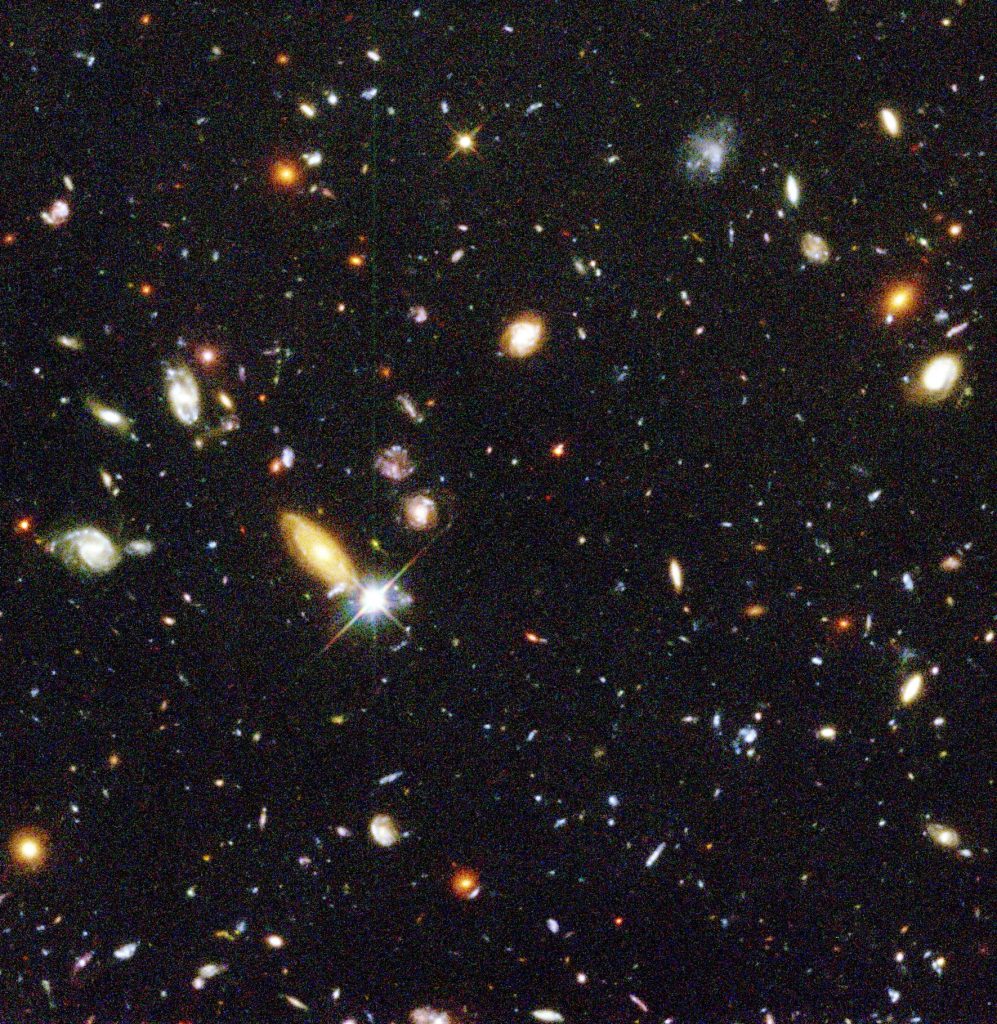
NASA, Robert Williams, and the Hubble Deep Field Team (STScI)
I never expected a small amateur telescope to reproduce a Hubble deep field, and that is not the point. What I wanted was to experience something of the same perspective through my own equipment: to collect photons that had travelled for hundreds of millions of years, then explore a frame in which every corner seems to contain another galaxy.
Abell 2151 provides that experience particularly well. Its bright members are identifiable, its unsettled structure gives the field a scientific narrative, and the surrounding background turns the image into more than a record of one cluster. It conveys space through the separation of galaxies and time through the age of their light. For me, that ability to feel both dimensions in a single photograph is one of the deepest attractions of astrophotography.
There is also pleasure in working at the boundary between seeing and knowing. The image can reveal morphology—the difference between a smooth elliptical and a flattened disc—but it cannot supply every distance or physical relationship by itself. An annotation catalogue, published redshifts and scientific studies become companions to the photograph. Processing ends, yet exploration continues. That makes a cluster field feel less like a finished trophy and more like a map with layers still to uncover.
Behind the Image
The tables below summarise the equipment and exposure settings used for this image of Abell 2151. The data were collected over multiple nights from Cambrai, South Australia, under Bortle 3 skies. Two details—the mount model and imaging dates—remain marked for confirmation before publication.
Equipment
| Component | Details |
| Target | Abell 2151 – The Hercules Galaxy Cluster |
| Constellation | Hercules |
| Imaging location | Meldanda, Cambrai, South Australia |
| Sky quality | Bortle 3 |
| Imaging dates | Jun, Jul 2026 |
| Telescope | Askar 107PHQ (107 mm f/7 Petzval APO refractor) |
| Camera | ToupTek ATR2600M monochrome |
| Filters | Antlia LRGB, 36 mm unmounted |
| Filter wheel | ToupTek 7 × 36 mm electronic filter wheel |
| Mount | Proxisky Ragdoll 17 |
| Guiding | Off-axis guider + ToupTek G3M2210 Mono |
| Image scale | 1.04 arcsec/pixel |
| Field of view | 1.76° × 1.14° |
| Capture / guiding | N.I.N.A. / PHD2 |
| Processing | PixInsight and Adobe Photoshop |
Exposure Details
| Filter | Subframes | Integration |
| Luminance | 130 × 300 s | 10 h 50 m |
| Red | 39 × 300 s | 3 h 15 m |
| Green | 40 × 300 s | 3 h 20 m |
| Blue | 39 × 300 s | 3 h 15 m |
| Total | 248 × 300 s | 20 h 40 m |
Image Annotation
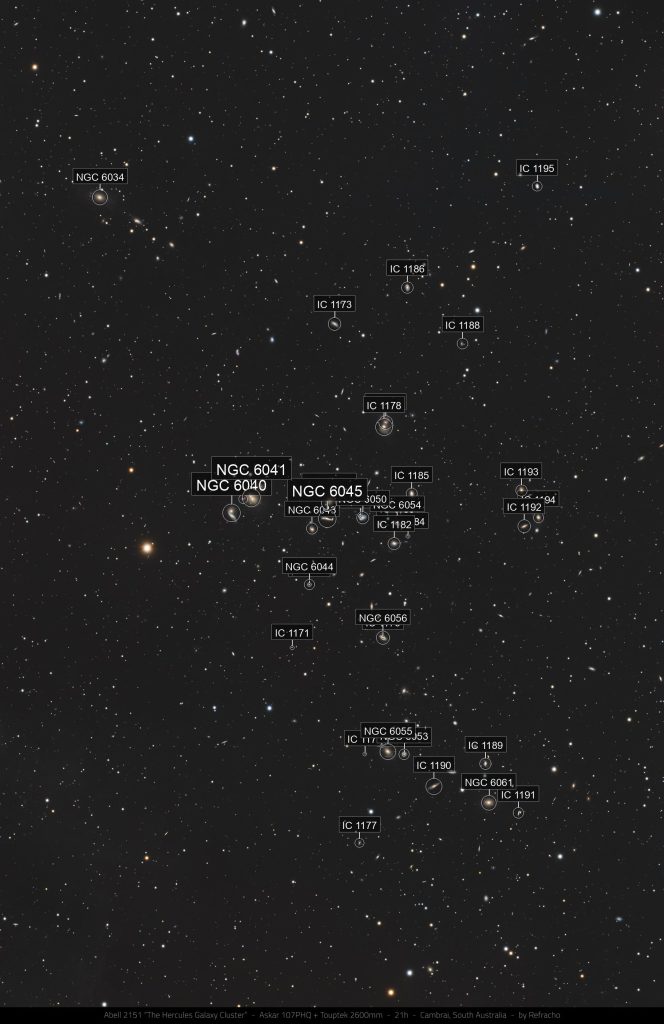
The annotated image turns the cluster into a map rather than a collection of anonymous smudges. NGC 6041 provides an elliptical landmark near the core; NGC 6045 offers a contrasting edge-on disc; and NGC 6040 shows the complexity of an interacting system. Redshift-based catalogues are the appropriate authority for membership, because apparent proximity in the image is not proof that two galaxies occupy the same region of space.